The first price customers see should be the price they pay.
Do you pass the 3 Step Pricing Check?
If you run a business, you must make sure that your customers know up front exactly how much they’ll pay. No nasty surprises later.
Sound tricky? This quick 3 Step Pricing Check will help you get your pricing right.
1. Do you show the total price up front?
How do you tell customers about what you sell and how much it costs?
Through a TV ad, an email or a page on your website, for example?
No matter how, you must show the total price up front – clearly and where customers are likely to see it.
Read an example
Joe is busy scrolling when he spots an ad for a gig.
The price he sees is: ‘£20 per ticket’.
But when Joe gets to the checkout, he discovers a hidden ‘£5 booking fee’.
Not good.
Solution: The business should have included the booking fee in the total price: ‘From £25 (£20 per ticket plus a £5 booking fee per order).’

2. Do you include all mandatory charges?
Do your customers have to pay any unavoidable fees (like a delivery or booking fee), taxes (like VAT) or other charges to buy your product?
If so, are you including them in the total price? Don’t save them for later or list them separately. Always include them in the price if marketing to customers – even if you use the same ads for trade customers.
What about optional delivery fees? Even though they don’t need to be included in the total price, still show them in your ad.
Read an example
Helen is drafting a quote for a customer.
The customer must pay VAT at 20% on top of the cost of the work (£280), so Helen includes that in the total price.
In the quote, she explains that the total price of £336 ‘includes VAT (£56)’.
One clear price, one happy customer.
3. If you can’t give the total price, is it clear how customers can work it out?
Maybe the nature of your product or service means you need extra information, like measurements?
That’s fine. Give the customer the information they need to work out the total price themselves.
Make sure this information is as prominent as the part of the price you do know.
Read an example
Tom is a carpenter. Among other things, he sells and fits wooden floors that are made to measure.
His website prominently says that the cost of wood flooring starts from £25 per square metre.
Directly below this, the page shows a flat fitting fee of £200.
This means Tom’s customers can work out exactly how much they’ll pay, for the product and fitting.
Passed this check?
If you answered ‘yes’ to all 3 questions, you’re probably in good shape. But remember, this isn’t a formal accreditation: you still need to review your pricing and make sure you’re getting it right.
If not, you may be breaking the law and undermining trust in your business.
Get more help
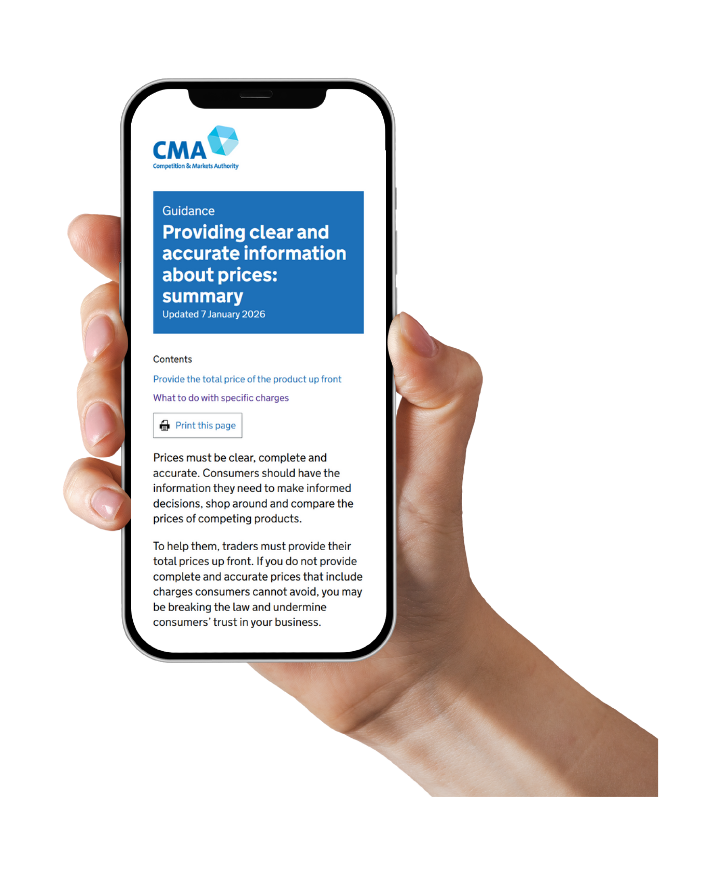
Don’t panic: the Competition and Markets Authority has guidance to help you stay on the right side of the law.
It explains what to do with specific types of fee or tax, and includes useful examples.